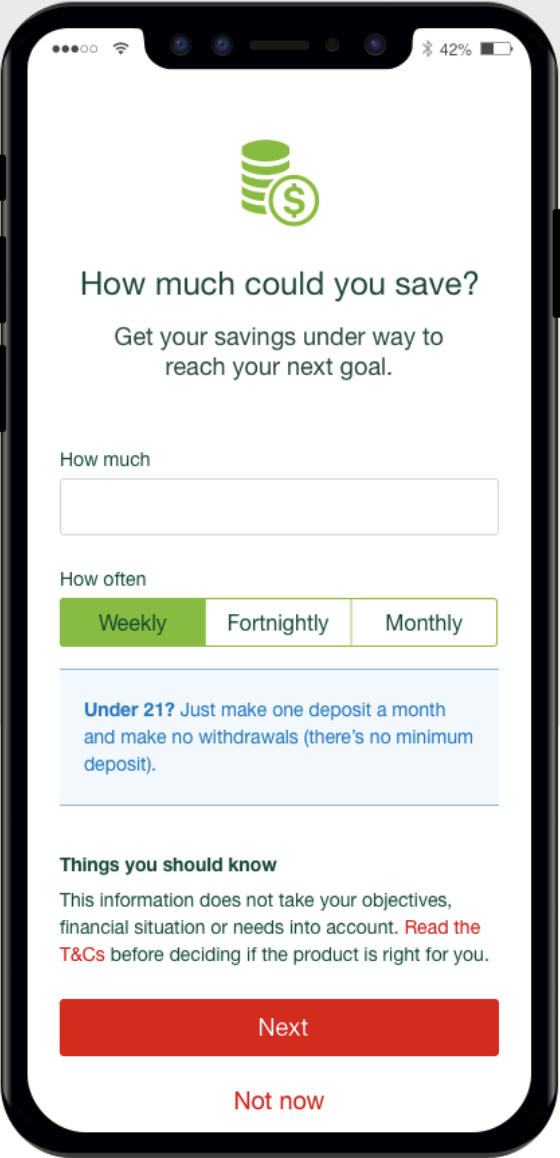
Saving Habit encourages customers to set up a recurring payment to their savings account — or open a new one — and regularly send money to it, turning the intention to save into a sustainable, automatic behaviour.
Most customers who want to save more money never get started — not because they lack the intention, but because setting up a recurring transfer is unintuitive, easily forgotten, or feels like a commitment they're not sure they can keep. Saving Habit was designed to remove every friction point between the intention to save and the first scheduled transfer.
The feature needed to work for two distinct customer states: those with an existing savings account who wanted to automate regular contributions, and those who hadn't yet opened a savings account and needed a reason to start. Both paths had to feel immediate, low-commitment, and rewarding from the first interaction.
Interviewed customers about their savings behaviour — why they wanted to save, where they got stuck, and what had worked for them in the past. Identified the "intention gap" as the primary design problem: customers knew they wanted to save but had no low-friction way to act on it in the moment.
Defined two flows — one for customers with an existing account and one for those who needed to open one. Mapped the decision points in each flow and identified where commitment devices (amount-first entry) would reduce hesitation.
Designed the setup flow in Figma with an amount-and-frequency screen as the entry point. Integrated inline account opening for new savers. Progress tracking and confirmation screens designed to give customers an immediate sense of having done something meaningful.
Usability testing confirmed that leading with amount selection (rather than account selection) reduced drop-off significantly. Iterated on the frequency options and the account-opening inline flow before handoff.
The Saving Habit setup starts with the simplest, most motivating question: how much do you want to save, and how often? By asking the amount and frequency before linking any account, the flow gives customers a sense of progress and commitment before they hit any potential friction point. The psychology is deliberate — once someone has chosen "$50 every fortnight", they're far more likely to complete the account linking step than if they'd been asked to pick an account first.
For customers without an existing savings account, account opening is embedded in the flow — not a redirect, not a separate process. They choose their amount, select "open a new account", and the account is created as part of the same journey.
After setup, the savings account home screen displays a running total and a visual progress bar towards the customer's stated goal, reinforcing the habit every time they open the app. Customers can adjust their transfer amount or frequency at any time without cancelling the habit entirely — a deliberate design decision to reduce full abandonment in favour of adjustment.
The feature was designed and delivered within Westpac's mobile design system, using shared components for account selection, form inputs, and progress indicators — ensuring the experience felt native to the broader app while introducing the new pattern cleanly.