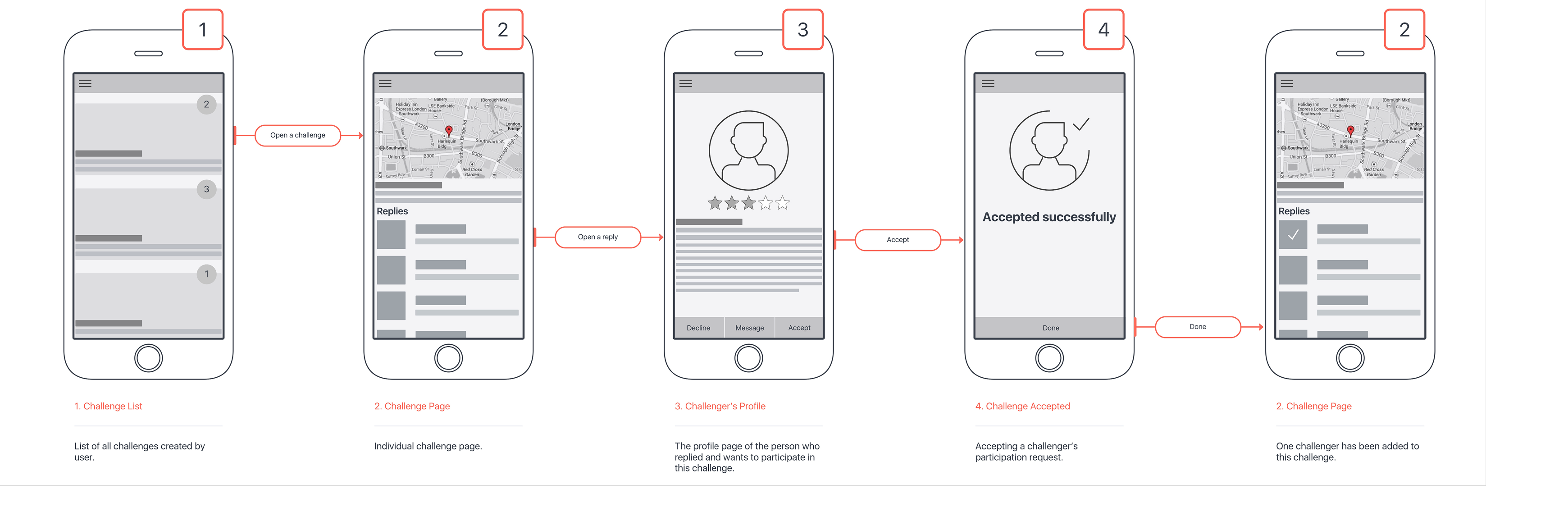
Social Fitness is for people who are interested in a specific fitness activity and have an agreement on the time and location. The app helps users find others to attend fitness activities with — and helps everyone arrange the time and place.
People are far more likely to commit to a fitness activity when they're doing it with someone else — but finding a compatible activity partner is surprisingly hard. Existing solutions either focus on professional coaching, broad social networks where fitness is secondary, or generic event listings that don't account for the logistics of arranging a specific activity between two or more people.
Social Fitness was conceived to solve the coordination problem: matching people who share an interest in a specific fitness activity, and then giving them the tools to agree on time and location quickly — so they can spend less time planning and more time moving.
Spoke with runners, cyclists, gym-goers, and team sport players about how they found people to exercise with. Identified a recurring theme: the logistics of coordinating — when, where, how to confirm — was often more exhausting than the activity itself.
Defined the core user flow: select activity → define availability and location range → browse compatible matches → propose a session. The scheduling step was treated as a first-class feature, not an afterthought, to prevent coordination falling back to DM threads.
Designed the full app in Figma — from onboarding (activity selection and availability setup) through browsing and matching, to the session proposal, confirmation, and post-activity feedback loop. Wireframes tested first, then high-fidelity with a dark, energetic visual system.
Prototype tested with participants across multiple activity types. Key finding: users wanted to see location proximity before skill level when browsing. Iterated on the browse card hierarchy accordingly. Finalized designs delivered with annotated specs and interactive prototype.
Social Fitness leads with activity selection — not a generic profile. When users onboard, they define which activities they're interested in, their general availability windows, and their preferred location or radius. This upfront context means that every match shown is already filtered for relevance: you only see people who do the same activity, in roughly the same area, at broadly compatible times.
Browse cards surface the essentials at a glance — activity, distance from you, available windows — so users can make fast, confident decisions about who to connect with. Tapping into a profile reveals more detail: their activity history, preferred intensity level, and any public sessions they've already scheduled.
Once two users connect, the session proposal flow handles coordination in-app. One user proposes a time, location, and activity duration. The other accepts, suggests an alternative, or declines. Once confirmed, both users receive a shared session card with map directions and a reminder before the activity. No need to exchange numbers or move to another app to finalise the plan.
The experience was designed as a native mobile app with a dark, high-contrast visual system — energetic enough to match the context of fitness planning, functional enough to make coordination feel effortless.