Web App · B2B
NAB Broker
Portal
A purposefully designed central touchpoint that empowers brokers to efficiently manage their pipelines, track application SLA response times, and monitor their personal performance.
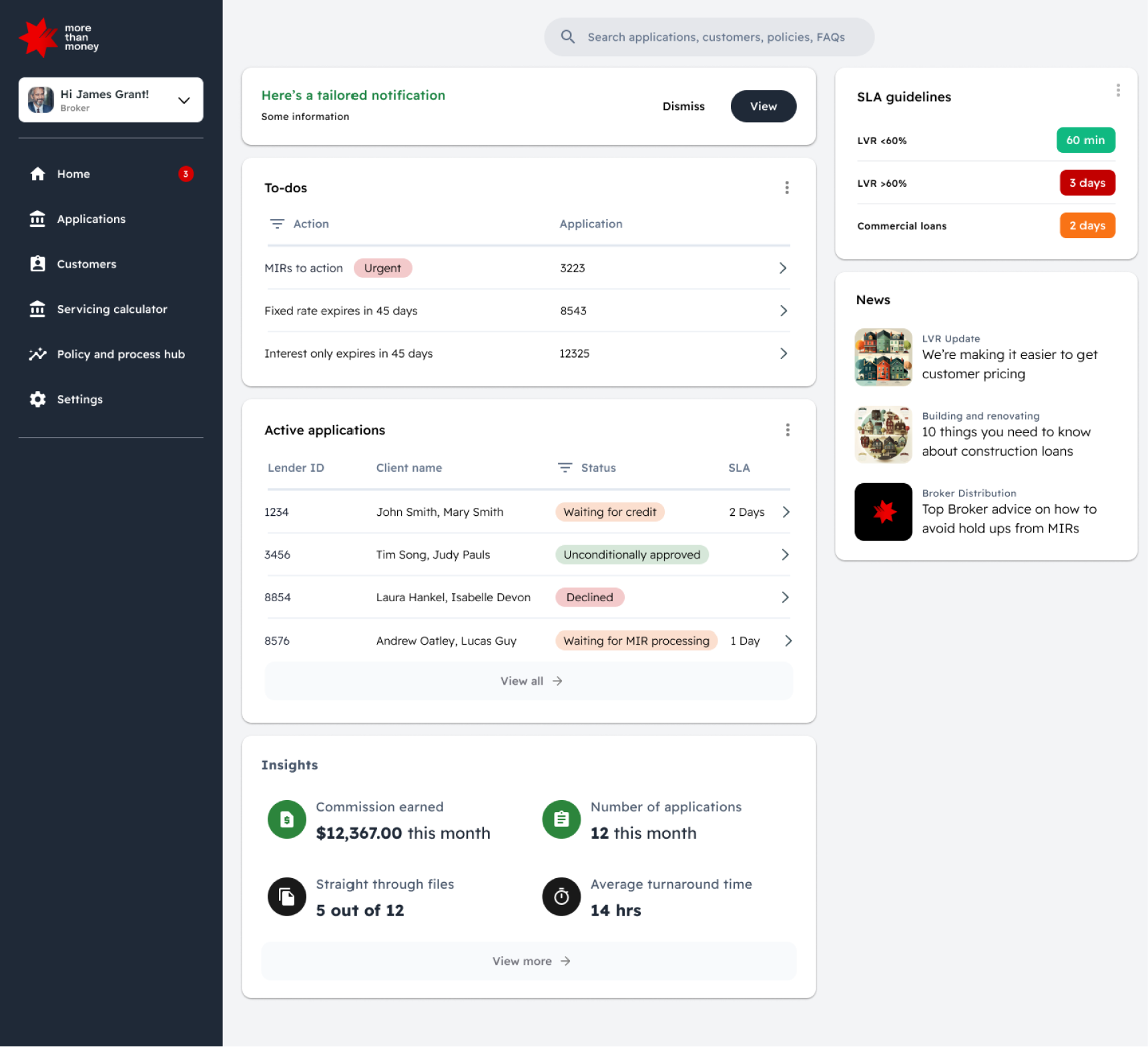
A purposefully designed central touchpoint that empowers brokers to efficiently manage their pipelines, track application SLA response times, and monitor their personal performance.
NAB's mortgage brokers were juggling multiple disconnected tools to manage loan applications, keep on top of SLA deadlines, and track their own performance. The fragmented experience created delays, introduced errors, and made it difficult for brokers to provide the responsive, informed service their clients expected.
In parallel, the Commission Ops team was managing broker and aggregator commission inquiries entirely through email and a patchwork of legacy systems — with no structured process, no single source of truth, and no way to efficiently investigate or resolve payment discrepancies at scale.
The Broker Commission Workbench was created to optimise the internal process of resolving brokers' and aggregators' inquiries related to commission payments. Previously, the Commission Ops team relied on email communication and navigating various legacy systems in a time-consuming manner to investigate and address payment discrepancies.
With the new workbench, this cumbersome process is streamlined. It enables the team to swiftly identify the root cause of any issues — providing clear explanations to brokers and aggregators for paid commissions, or in cases of bank errors, accurately calculating and adjusting payment amounts. By centralising and automating these tasks, the Workbench significantly improves efficiency and accuracy in managing commission-related queries.
Following an insightful discussion with the Product Owner and the Commission Ops team, it became evident that the existing process was rooted in legacy practices and lacked clear documentation or rationale. I embarked on a comprehensive investigation to understand the problem space, system constraints, and the pain points experienced by the team.
I facilitated a series of workshops with the Commission Ops team, delving into the intricacies of handling inquiries across various home loan products and loan structures. I also engaged in multiple sessions with system architects who guided me through the interconnectedness of the existing systems — forming the foundation for all subsequent design activities.
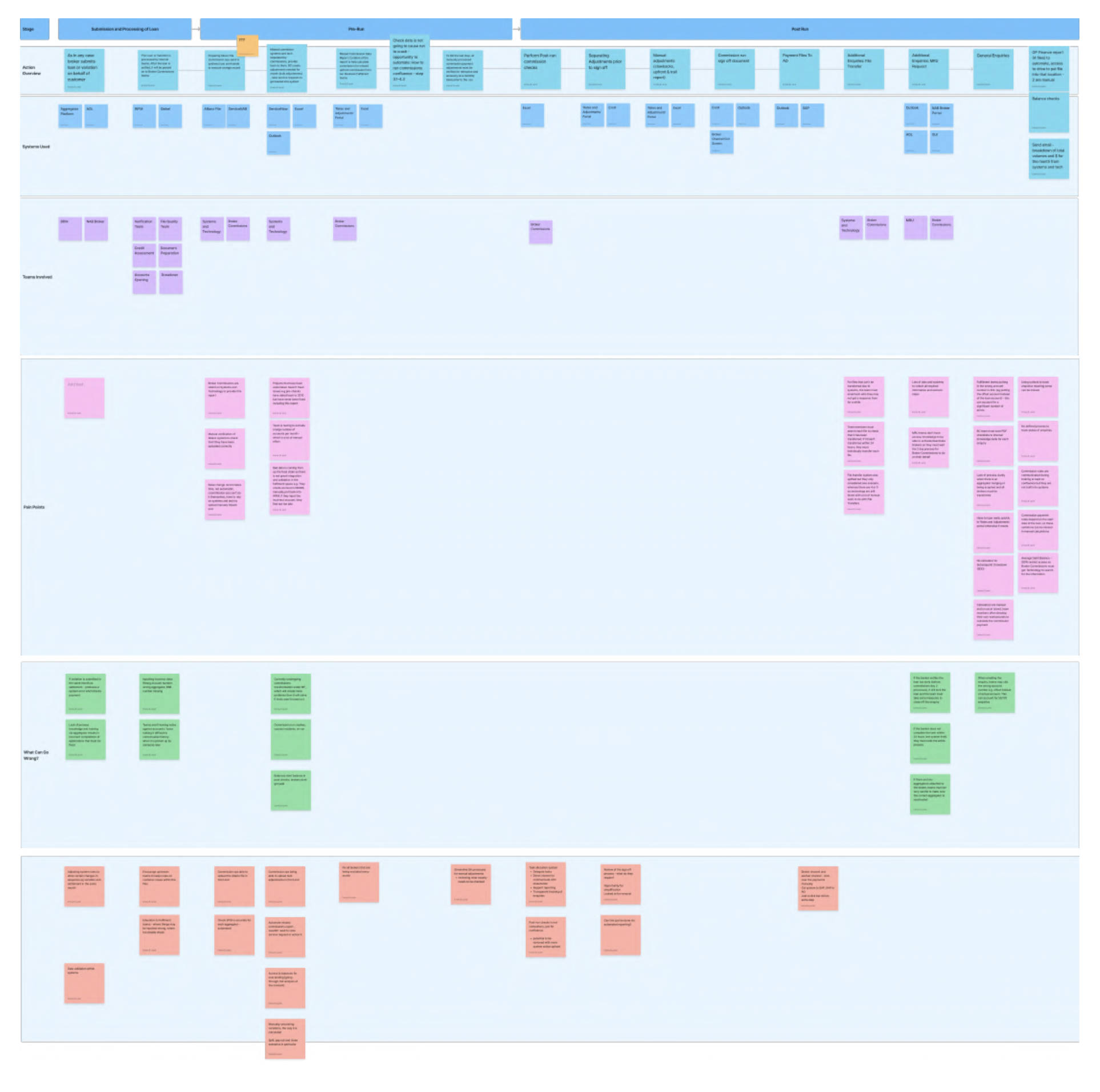
Output from a series of facilitated workshops with the Commission Ops team. Sticky notes were clustered across swim lanes to surface recurring pain points, system dependencies, and opportunities across the full commission inquiry lifecycle. This artefact formed the evidence base for all subsequent design decisions.
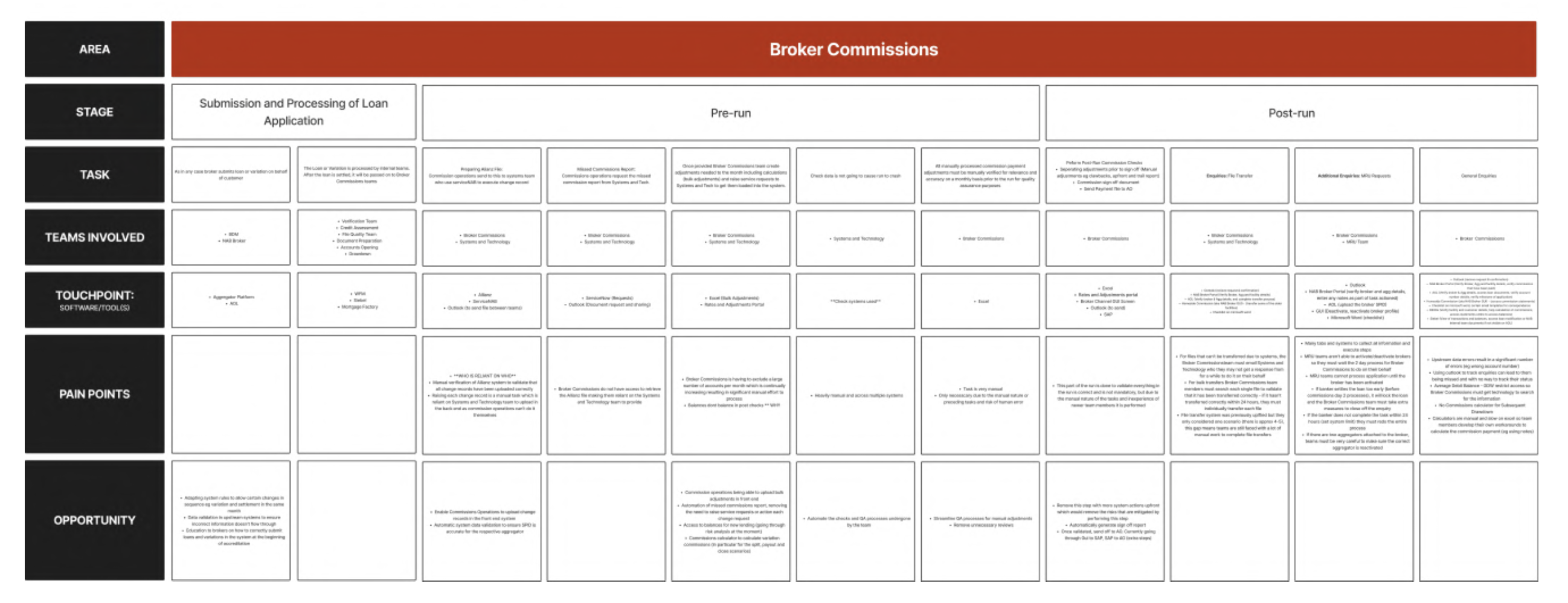
A comprehensive service blueprint mapping the Broker Commissions process across three stages — Submission and Processing of Loan Application, Pre-run, and Post-run. Rows document Stage, Task, Teams Involved, Touchpoint/Software/Tool, Pain Points, and Opportunity — giving stakeholders a shared, unambiguous view of where the current process broke down and where design could intervene.
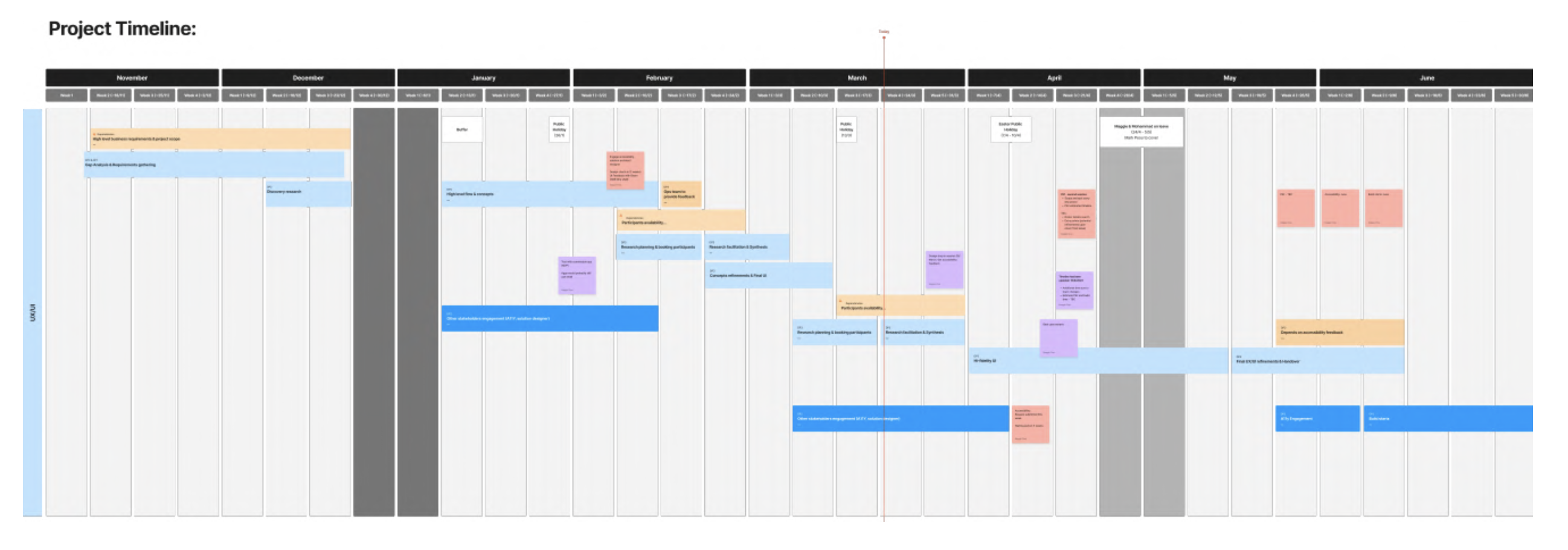
Once a comprehensive understanding of the problem space was established, I devised a project timeline and collaborated with different stakeholders to reach agreement on deadlines and delivery milestones. The timeline spans research, iteration, and delivery phases — ensuring all workstreams were visible, sequenced, and aligned across product, design, and engineering.
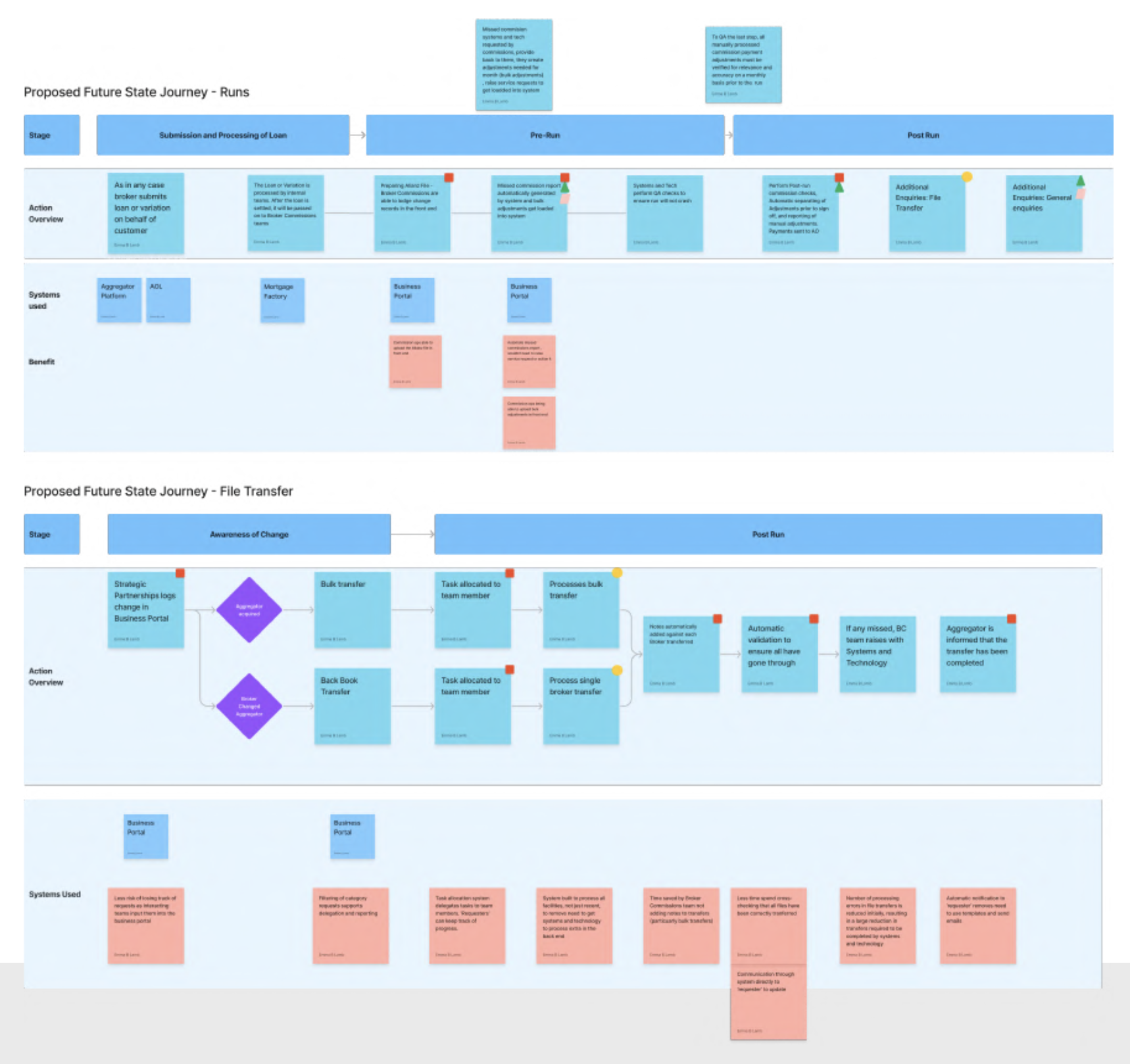
Two proposed future state journey maps defining the redesigned workflows — one for the Runs process (covering Submission and Processing, Pre-Run, and Post-Run stages) and one for the File Transfer process (covering Awareness of Change through to post-run resolution). These low-fidelity flows were shared with the Product Owner and stakeholders for feedback before progressing to higher fidelities.
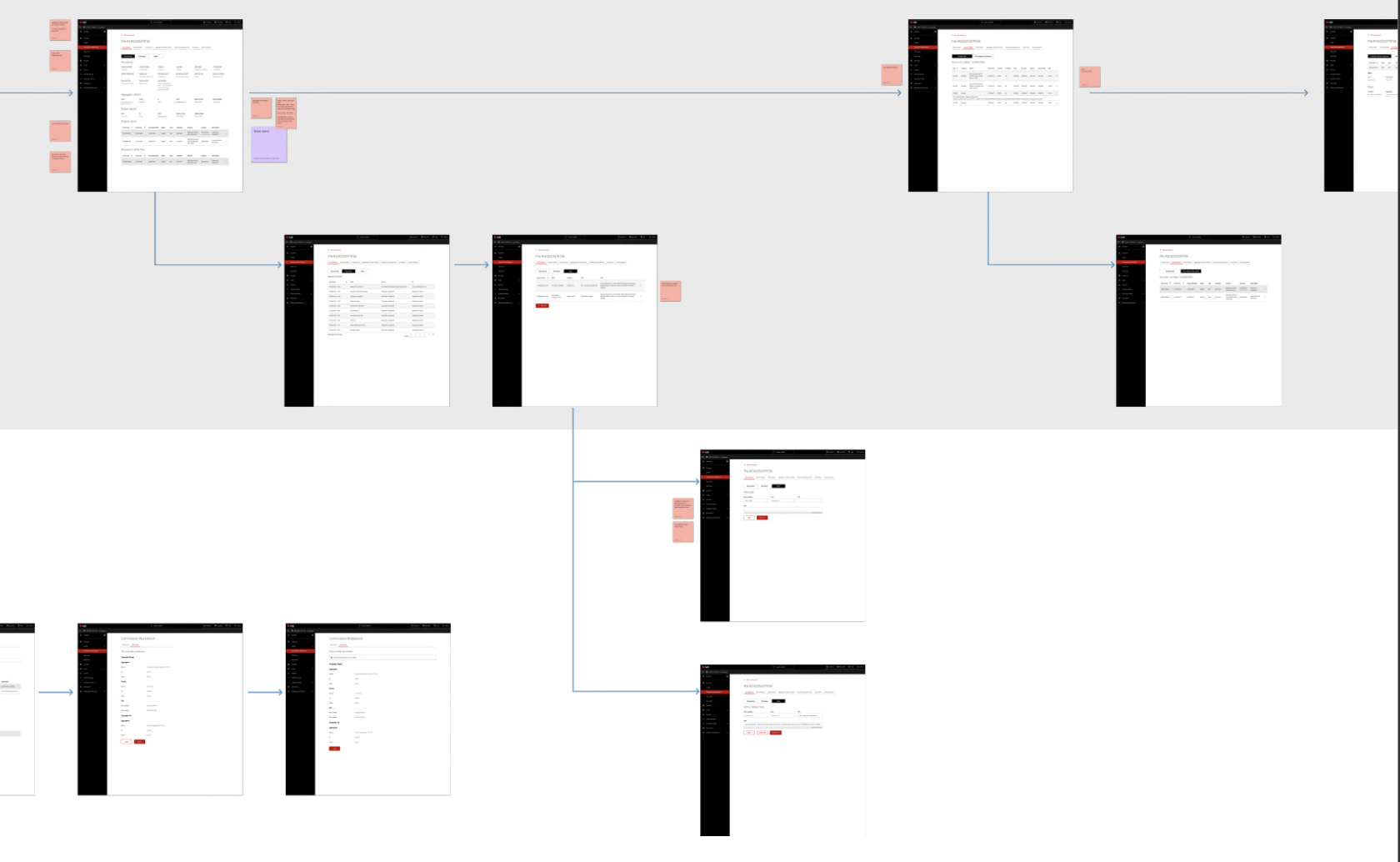
Mid-fidelity screens designed for the approved flow, connected into an interactive prototype for usability testing. Two rounds of testing were conducted — the first with five participants to capture initial feedback, and the second to validate iterations and add finishing touches. Once the flow was finalised and high-fidelity screens were created, multiple handover sessions were facilitated with the development team to ensure a smooth and seamless transfer.
The broker-facing portal was purposefully designed to cater to brokers at different stages of their day — from scanning urgent to-dos first thing in the morning, to checking SLA guidelines before a client call, to reviewing commission earned and turnaround times at end of day. Tailored notifications surface the most time-sensitive information first, so nothing falls through the cracks.
The Active Applications table gave brokers instant visibility into where each loan sat in the process — with status labels and SLA countdowns removing the need for status-chasing calls. The Insights panel consolidated performance data (commission, application volumes, straight-through processing, and turnaround time) that had previously been scattered across separate reporting tools.
Together, the broker portal and the Commission Workbench addressed both sides of the same problem — giving brokers a clear view of their work, and giving the Ops team the tools to resolve their queries quickly and accurately.